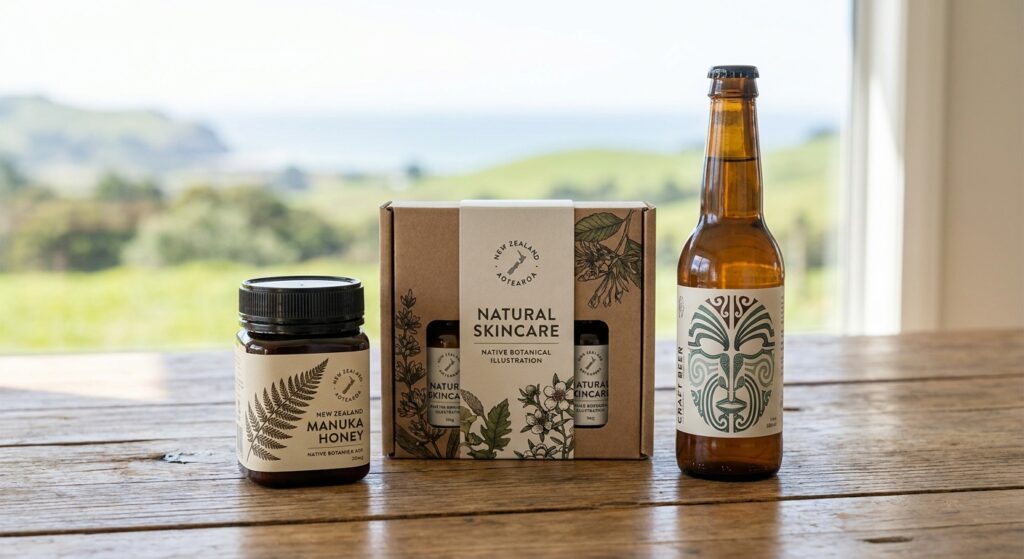
Packaging design for a NZ product brand starts with two connected questions: what must the customer understand, and what can the chosen supplier manufacture? A useful brief brings the product owner, designer and printer together before artwork is released.
This agency-authored guide explains how to scope a label, box or product range. It is a planning checklist, not a ranking of providers or a guarantee of retail acceptance.
Define the product and the packaging job
List each product variant, size and pack format. Separate a label refresh on an existing container from a new structural packaging project. Record where the pack will be used: a physical shelf, a chilled cabinet, a delivery parcel or another environment. These are inputs to assess, not reasons to assume a complete rebrand is necessary.
- What is included: front, back, sleeve, carton, insert or shipping packaging?
- Which names, descriptions, quantities and variant identifiers are final?
- Who supplies photography, illustrations, barcode assets and approved copy?
- Which supplier is producing the pack, and when must they receive approved artwork?
Get the printer’s specification before final artwork
Ask the actual production supplier for its current dieline and artwork requirements. Confirm dimensions, safe areas, bleed, colour handling, image resolution and file format for that job. A generic 3mm bleed rule is not a substitute for a supplier specification. Check how cut lines, folds, varnish, foil, white ink or other finishing layers should be named and separated where relevant.
Keep the supplied structural template identifiable. If the structure changes, confirm the revised version with the supplier before adapting the artwork. A digital mockup can help discuss the concept, but it does not prove that a pack will fit, print or perform as intended.
Build a readable product range
Set a consistent order for brand, product name, variant and supporting information. Test whether customers can distinguish similar flavours or sizes without relying only on colour. Review the design at actual size, including small copy, seams, folds and curved surfaces.
Maintain a variant register showing the approved product name, artwork version, copy owner and approval status. An editable system can support later adaptations, but each new pack still needs checking. A range of two products does not automatically require a full brand overhaul.
Separate design approval from product-information review
The business should identify who is responsible for the accuracy and approval of label content before print release. For food products, MPI’s retail food labelling guidance explains that requirements and exceptions depend on the product. It covers required information and rules for optional claims. Arrange an appropriate review for your product; a visually approved layout is not evidence of compliance.
For other product types, establish the relevant information and review requirements separately. Do not copy food-label assumptions to cosmetics, household goods or another category. Keep approved copy and any requested changes in one controlled record.
Agree the proof and release process
- Content check: compare every variant with the approved copy and product register.
- Production check: have the supplier assess the artwork against its specification and record any required corrections.
- Proof review: agree what the available proof demonstrates. A screen PDF, a printed colour proof and a manufactured sample answer different questions.
- Release: name the person authorised to approve production and retain the exact released version.
Where practical, review a physical sample in its intended setting and check the assembled pack. Confirm the scope and cost of proofs and samples before ordering them. Do not assume that a colour seen on a monitor is an exact production match.
Compare quotes on the same scope
Ask each provider to state the number of variants and formats, concepts, revision rounds, production-artwork work, supplied files and handover rights. Separate design fees from printing, packaging manufacture, photography, specialist label review and later updates. Build the schedule around confirmed inputs and approvals rather than a universal turnaround promise.
No Brainer is based in Auckland. Our graphic design service is a starting point for discussing the design scope and the production partners involved. Bring your current files and supplier specification so we can identify what needs to be designed, supplied or checked before quoting.
Packaging questions
Do I need a new brand before designing packaging?
Not always. Review your existing logo, colours, typography and intended product range first. A targeted packaging update may be enough; a wider brand project should have a specific reason and agreed scope.
What should I send with a packaging design brief?
Include the product and variants, approved copy, intended sales channels, existing brand assets, pack dimensions, printer contact, supplied dieline and any production constraints. Mark missing inputs and who will approve them.
Is 3mm bleed correct for every pack?
No single bleed or colour setup suits every packaging job. Use the selected printer’s current specification for the actual material, process and finishing, and confirm how cut, fold and other production layers should be supplied.
Can existing template artwork be used?
Assess the licence, editable source, dimensions, image quality and printer requirements. The software name alone does not establish whether artwork is suitable for production.
Who approves food-label information?
Agree an appropriate product-label review with the business before print release. Design approval is separate from checking the accuracy and suitability of ingredients, claims and other required information. Use current official guidance and specialist advice where needed.
Will new packaging secure a retail listing?
There is no guaranteed listing or sales outcome. Packaging is one part of the product proposition; a retailer also has its own commercial and product requirements.
How should I compare packaging design quotes?
Compare the same variants, formats, concept and revision scope, artwork deliverables, proofing responsibilities and exclusions. Confirm whether production, specialist review, photography and future adaptations are separate.
What files should the final handover include?
Agree the printer-approved production files, relevant editable artwork and usage rights, approved copy and variant register, proof approvals and a clear version naming system. The exact file specification depends on the job.
Related planning guides
- Choosing a branding agency for NZ ecommerce
- Rebranding a NZ business: customer and website checklist
Discuss your packaging design brief with No Brainer. Include your product range, current artwork and printer requirements; no retail listing or sales outcome is promised.