Ecommerce web design
for Auckland businesses.
Give shoppers a clear route from finding the right product to placing an order.
No Brainer Creative designs ecommerce websites for Auckland and New Zealand businesses. We bring the storefront, product information and buying journey into one brief, with Shopify design experience you can see in our work.
Whether you are opening an online store or improving an existing one, we start with your catalogue, customers and order process. The result should be a store your customers understand and your team can operate.
Make the next step
easy to understand.
A good-looking homepage is one part of an online store. Customers also need to find products, choose the right option, understand the total order and know what happens after payment.
We plan the design around those decisions. Your scope can cover a new Shopify storefront, a redesign of an existing store, or a review of the product and checkout journey before choosing what to rebuild.
For a service website or broader platform discussion, explore our Auckland web design service. This page focuses on the additional work involved in selling products online.
Catalogue and navigation
Group products into useful collections or categories. Plan menus, filters and search around how customers shop, including the information they need before they open a product page.
Product pages and variants
Present product details, images, prices and available options clearly. We agree how sizes, colours, stock states and other variants should be shown, rather than relying on a layout that suits only one simple product.
Mobile shopping layouts
Review product browsing, option selection, cart controls and important information at mobile sizes. Content should remain readable, and the primary action should be easy to find and use.
Cart, delivery and payment setup
Scope delivery zones, collection options and the payment connections your business needs. Your team supplies the approved trading rules and owns the relevant provider accounts. We check the agreed customer journey before launch.
Store operation and handover
Agree who updates products, handles orders and answers customer questions. The handover should explain the tasks your team needs to perform and identify which changes require further support.
Ecommerce design.
Real project evidence.
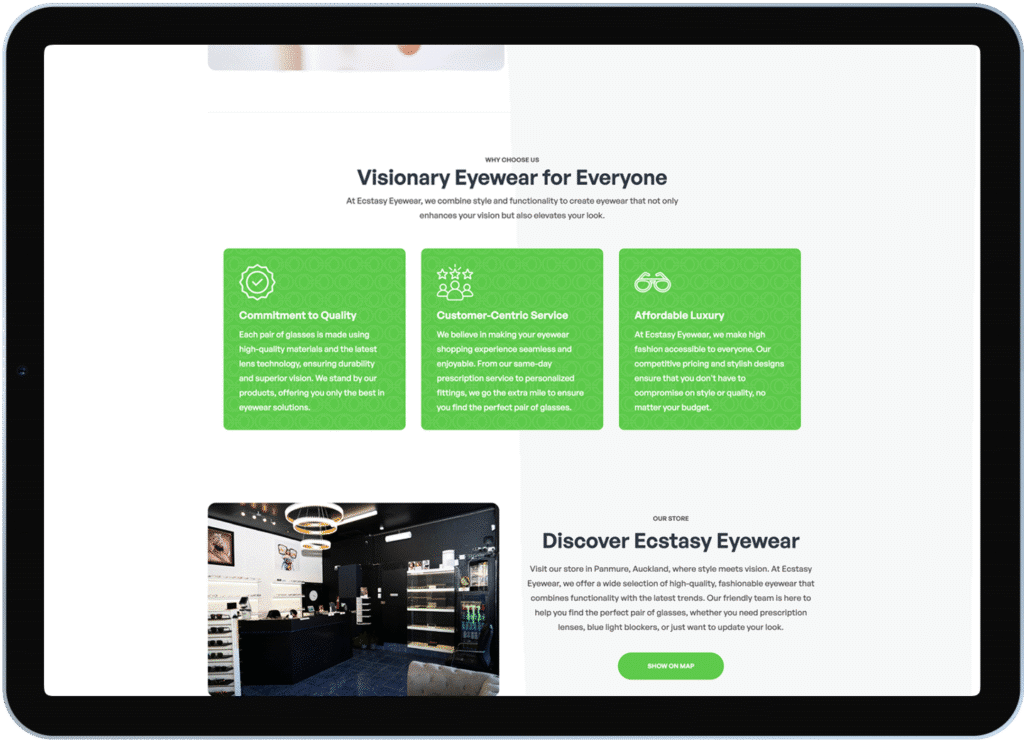
Our Ecstasy Eyewear project includes Shopify web design, branding and product presentation. You can see the storefront layouts and mobile product screens in the case study.
DesignRush’s published design analysis credits No Brainer Creative and discusses the site’s visual direction, navigation and product browsing. It is existing design coverage; it is not evidence of a particular sales increase.
Other catalogue examples include the Deccan Arts artwork shop and gallery and the Fit Easy Doors Shopify project. Deccan Arts brings artwork products and the artist’s story together; Fit Easy Doors organises door ranges, hardware and enquiry routes. Explore the project pages for the actual layouts and scope.
Plan the store
around the business.
Choose the platform with the scope in view
Bring your current platform, product count, variants and essential tools to the first conversation. We discuss what should stay, what needs to change and whether the proposed platform fits the way you sell.
A familiar platform still needs a considered build. Subscription plans, apps, payment processing and specialist integrations can add ongoing costs. Our proposal separates the design and build from the third-party services and continuing support that apply to your store.
Agree integrations before promising automation
If stock, fulfilment, accounting, bookings or customer follow-up needs a connection, we check the available route and define what will be tested. We do not assume that two systems will stay in sync simply because each has an integration option.
Our CRM and marketing automation service can support agreed follow-up processes where the right connection and customer permissions are in place. Data ownership, exception handling and the person responsible for each step belong in the brief.
Build a store people
and search engines can navigate.
We scope useful collection and product content, clear page titles, internal links, mobile layouts and the technical checks relevant to the build. Product information needs to describe what you actually sell, with accurate prices, availability and approved delivery information.
Google’s ecommerce site-structure guidance recommends links from categories to the products people should be able to find. A search box alone is not a substitute for a crawlable catalogue.
If you are replacing a store, we review important existing URLs and plan relevant redirects. We also check the agreed sitemap, canonical and indexing settings. Ongoing SEO work and paid campaigns can be scoped alongside the build, with their own priorities and reporting.
A clear launch checklist.
A practical handover.
Before development starts, agree the pages, product data, connections and test cases included. A launch decision should use the actual store, not just a screenshot of the homepage.
Browse and choose
Check the agreed collection links, product images, variant selectors and stock messages. Include mobile browsing and at least the product types that create different buying paths.
Order and communicate
Check cart totals, delivery or collection choices and the agreed payment test route. Review order information and customer notifications using a planned test process.
Operate and measure
Review the order handover and the events being measured. Keep a product view, checkout start and completed order separate, and confirm how test orders are excluded from business reporting.
Any live payment or customer-message tests are agreed with the business first. We record what was checked, what remains outside the scope and who owns the next step after launch.
What to bring
to the first conversation.
A link to your current store is useful, but a new business can start with a product list. Tell us who buys, where you deliver, the types of options customers choose and how orders are handled today.
Bring the systems that must connect, your available photography and copy, any deadlines tied to a real launch, and a realistic budget for both setup and continuing costs. Identify which products need unusual handling or information before purchase.
Use our website project brief to organise the basics. For a replacement store, our redesign scope and budget guide explains the questions worth settling before comparing quotes.
Ecommerce website questions,
answered plainly.
Do you design Shopify websites in Auckland?
Yes. No Brainer Creative is Auckland based and has Shopify design work in its portfolio, including Ecstasy Eyewear. We discuss your catalogue, brand, buying journey and store operation before agreeing the project scope.
Can you improve an existing online store?
We can review the existing store and the problem you want to solve before recommending a rebuild. The useful starting point might be navigation, product content, mobile layouts, checkout information or a specific connection. Access and ownership are checked before implementation.
How much does an ecommerce website cost?
The quote depends on product and variant complexity, design requirements, content, migration, integrations and testing. We distinguish the project fee from platform subscriptions, apps, payment-provider charges and agreed support. Ask for a scope based on your catalogue rather than an assumed one-size price. Shopify explains its types of platform and usage charges in its help centre.
Will the website include SEO?
The build scope can include agreed page titles, useful product and collection structure, internal links and technical launch checks. Ongoing keyword research, content and visibility work need their own scope. We do not guarantee a Google position or assume that launch checks complete an SEO programme.
Can you connect stock, shipping or customer systems?
We assess the tools and available integration route first. The proposal should state what data moves, which system is the source of truth, who handles exceptions and how the connection will be tested. A custom connection or paid app is included only when specifically agreed.
Will my team be able to update products?
We plan the handover around the tasks your team needs to own, such as adding product details, changing approved content and managing orders. The exact workflow depends on the chosen platform, permissions and any connected stock system.
Turn the store brief
into a clear next step.
Tell us what you sell, how you fulfil orders and where the current buying journey gets difficult. We will help define the most useful work to start with.