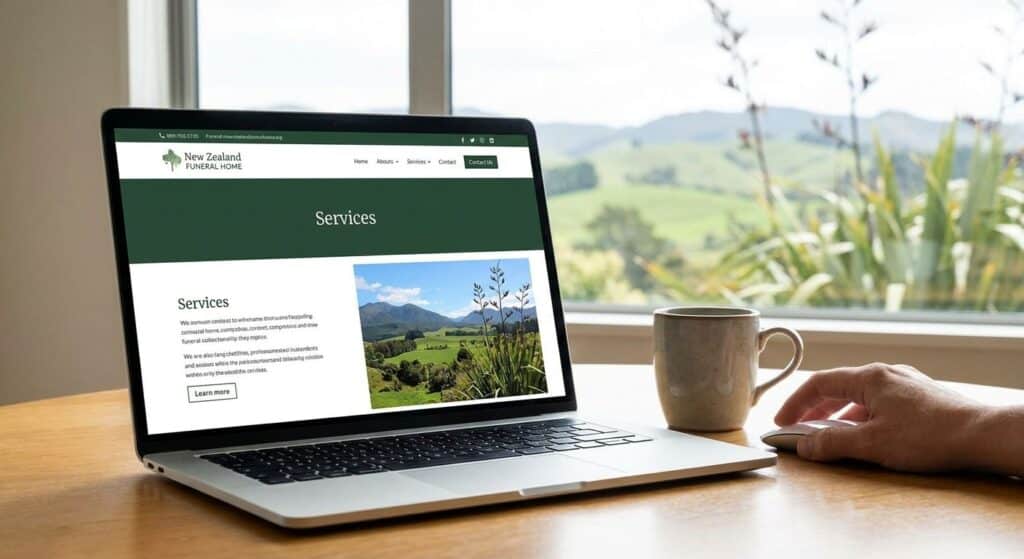
A funeral-home website should help people find clear, accurate information and the appropriate way to contact the business. Start the project with those tasks, the organisation’s actual services and the staff who will maintain the information.
This is an agency-authored website planning guide from No Brainer Creative in Auckland. It is not funeral-arrangement advice or a claim that one design approach is right for every provider. The funeral home approves its service information, wording, availability and publishing process.
Define the main visitor tasks
People may visit to contact the team, understand services, find a location or read a published notice. Others may be researching future arrangements. A useful brief distinguishes those tasks instead of assuming all visitors are in the same situation or want to complete an online form.
- Make the correct phone number and contact route easy to identify.
- Show real locations and practical visiting information.
- Explain available services in approved, plain language.
- Describe the actual process after a message or request is received.
- Provide an appropriate route to approved notices or service information where these are offered.
If the business offers urgent or after-hours assistance, confirm the contact arrangements before publishing them. Do not add a round-the-clock promise simply because it is common in another provider’s website.
Plan content and approval responsibilities
Agree which pages need service information, current pricing or cost explanations, staff details and photographs. The business supplies and approves the information; the website team should not invent packages, professional credentials, cultural capabilities or service availability.
Choose imagery and tone with the organisation, using authorised materials that represent the real business. Make text readable, navigation understandable and contact options easy to find. Test those decisions with the people responsible for the site rather than claiming that a colour, photograph or template guarantees trust.
Specify notices and tribute publishing carefully
If notices, tribute messages, service calendars or livestream links are required, treat them as operational features with named owners. Record who approves a notice, checks dates and names, publishes updates and handles corrections. Do not assume a website maintenance package includes these publishing duties.
For visitor submissions, agree moderation, notification and removal or correction handling before launch. Specify which information should be public and how external providers are involved. Do not publish private family information or infer permission to use names, images or messages.
A livestream link may lead to a separate service with its own access and availability requirements. Include the relevant checks and an appropriate contact route in the project plan; do not promise a functioning broadcast from the presence of an embedded player alone.
Assess the current website before choosing a rebuild
List demonstrated problems: incorrect information, inaccessible navigation, a failed contact route, unsupported software or a publishing process staff cannot use. Check which can be repaired and which require a larger change. Website age alone does not establish that it needs replacing.
A custom build, managed platform or supported existing system can each be appropriate depending on the requirements. Compare content control, editing permissions, ongoing costs, integrations, backups and handover. Our platform migration guide can help frame that discussion without assuming migration is always necessary.
Make usability and performance part of acceptance
Check relevant pages on phone and desktop: contact information, menus, notices, forms and any external destination. Include readable text, keyboard access, clear labels, visible focus and useful error messages. Avoid unexpected media playback or intrusive elements that interfere with reading or navigation.
Measure actual performance issues and agree representative test conditions. Google’s page experience guidance explains that good Core Web Vitals do not guarantee top search rankings. A single loading threshold is not proof that a family can find information or contact the business successfully.
Keep technical checks specific. Optimising images or repairing a script may address a demonstrated problem without a rebuild. Record lab-test conditions and distinguish those observations from real-user data and business outcomes.
Keep local information consistent
Check the existing Google Business Profile, website contact details and genuine location pages together. Accurate information should describe where the business operates and which contact details apply. Do not invent branches or duplicate pages for surrounding places solely to target searches.
Search visibility, a map result and the website journey are related but different. Our local profile planning guide provides questions for that part of the scope. Neither a redesigned page nor profile edits guarantee a particular position.
Agree launch, handover and ongoing support
Identify important existing URLs and published information before moving a site. Plan relevant redirects where pages change and preserve useful content. Agree how notices and other updates will be handled during the transition.
A controlled launch checklist should cover the agreed phone links, contact destinations, forms, notice publishing and external links. Test submissions or calls need an authorised diagnostic plan; do not create fictitious public notices or send unexpected messages as a shortcut.
Define who owns the domain, website, hosting and relevant service accounts. Document software maintenance, backup checks, publishing access, third-party dependencies and what support includes. Our website care guide helps separate those responsibilities from content and operational work.
Prepare a practical website brief
Bring the current website, genuine locations, page list, approved content and publishing needs. Identify the team member who can approve information, the people who will use the editor and any external notice or livestream service. Record real deadlines, budget and ongoing support expectations.
Our Auckland web design service can be scoped around those requirements. Send your website brief or call 022 125 2166 to discuss the work. No Brainer is based in Auckland and works with New Zealand businesses.
Frequently asked questions
What should a funeral-home website make easy to find?
The business’s accurate contact details, location, available services and approved next steps. Any urgent or after-hours contact statement must reflect the actual arrangements.
Does every funeral home need a custom-built website?
No. Assess the required content, publishing workflow, accessibility, integrations, ownership and support. A current platform may be suitable; compare the specific scope rather than assuming one delivery model always wins.
Should an older website automatically be replaced?
No. Review its content, usability, technical condition and editing requirements first. Targeted repairs may be sufficient; a rebuild needs a demonstrated reason and a migration plan.
Can a website include notices, tributes or livestream links?
These can be scoped, but responsibilities must be explicit: who approves and publishes information, moderates submissions, manages corrections and controls access or availability. An embedded link is not proof the external service works end to end.
What speed result should the project promise?
Agree representative pages, devices, measurement conditions and appropriate acceptance checks. A lab score or loading threshold alone does not guarantee search rankings or successful contact journeys.
What should ongoing website support cover?
Define hosting, software maintenance, backups, form checks, content publishing, notice corrections, third-party services and response arrangements separately. Do not assume a care plan includes every operational task.
How should website results be reported?
Keep visitors, phone-link clicks, connected calls, general enquiries and accepted arrangements separate where these can be measured appropriately. Exclude internal tests and document missing data.
Can No Brainer help plan the website?
No Brainer is an Auckland agency offering website design and marketing services. Share your current site, publishing needs and contact process so the proposal can define the required work. This guide does not claim a verified funeral-sector client outcome.