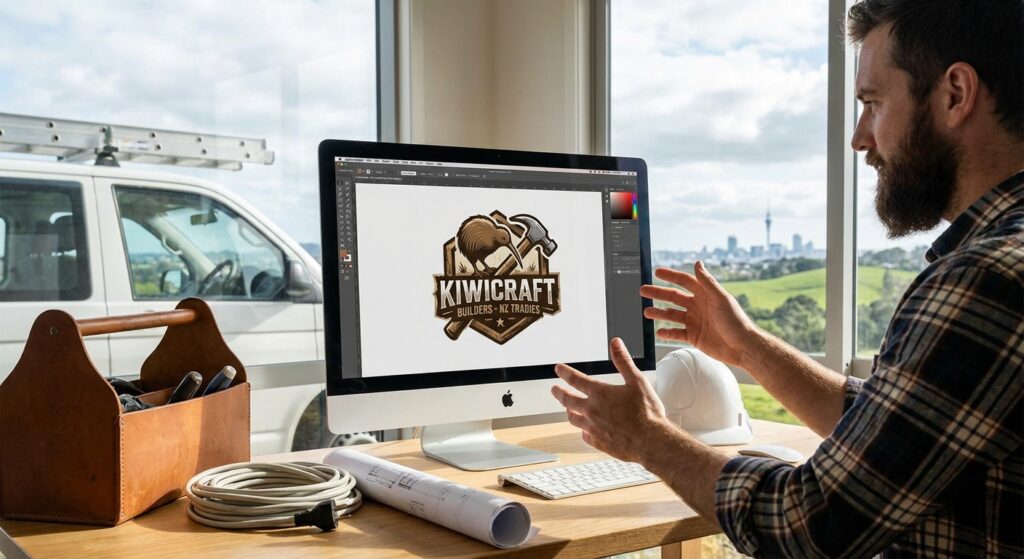
A tradie logo needs to work where the business actually uses it: on a quote, vehicle, website, job sign or garment. Start the design brief with those applications and the files you already have, rather than choosing a supplier from a universal best-to-worst list.
This guide is written by No Brainer Creative, an Auckland design and marketing agency. It explains project questions and practical checks. It does not rank logo tools or providers independently, promise enquiries, or provide legal clearance for an identity.
Define what should stay and what needs repair
Record the business name, genuine services and audiences. Bring the current logo, earlier artwork and examples of how it appears in use. An existing identity may have useful recognition even if the files or applications need work.
List specific problems: text that is unreadable at the required size, a missing artwork file, inconsistent colours, an outdated phone number or a supplier unable to reproduce the current design. A useful logo can be retained while these issues are addressed. The software used to create it does not by itself establish whether it must be replaced.
Write an application brief
- Website: header layout, phone view, small icon and readable contrast.
- Quotes and invoices: editable template, contact details and a version staff can use consistently.
- Vehicles: actual vehicle model, usable panels, contact information and installer requirements.
- Workwear: garment, placement, reproduction method and supplier proof or sample.
- Site signage: intended size, viewing context, production process and approved information.
Not every business needs every item at once. Identify the applications that matter now and those that can be added later. Our construction branding guide includes a broader rollout and application register.
Test the design in context
Review the name and mark at the sizes actually required, not only in a large presentation. Check suitable colour, single-colour and reversed versions against relevant backgrounds. Some applications may need an agreed alternative layout or simplified mark; having variants is not automatically a design failure.
Use the correct vehicle template or sign dimensions and obtain requirements from the production supplier. Embroidery, print and vinyl cutting have different constraints. Ask the supplier to review the artwork and confirm an appropriate proof or sample before manufacture.
Check spelling, business details and legibility separately from design preference. An attractive mock-up is not a production approval, and an approved logo is not evidence that a completed vehicle installation or garment will meet every requirement.
Agree files and rights as separate questions
Identify the artwork formats and editable files included in the handover. Vector artwork can be useful for scalable reproduction; transparent image exports can support ordinary website and document uses. The actual file list depends on the design and supplier requirements.
Also ask what the agreement says about ownership, licensing, fonts, icons, stock assets and later editing. Do not assume that receiving an SVG, EPS, PNG or source file answers those questions. Ask for clarification before commissioning or production and obtain appropriate advice where legal clearance is needed.
Apply the same questions to a freelancer, signwriter, agency or design tool. Avoid unverified assumptions about a provider’s standard packages, export options or commercial terms. A cheaper or more expensive route still needs a clear deliverable and approval process.
Plan feedback and approval
The proposal should explain discovery, concepts, feedback, revisions and final approval. Nominate a decision-maker and collect feedback around the agreed brief. Do not assume a fixed revision count, unlimited changes or a standard turnaround without a written scope.
Ask how out-of-scope changes are handled and which dependencies affect delivery. If printing or installation has a real deadline, include proof approval, supplier lead time and any material constraints in the plan rather than treating design delivery as the final production date.
Connect the identity to clear website information
The logo, business name and contact details should be used consistently across the applications in scope. A website still needs useful service content, relevant project information and an understandable next step; a new mark does not replace those tasks.
Our web design service can address website requirements, while the tradie SEO scope guide covers search work separately. Do not present a logo refresh as a guaranteed ranking or enquiry improvement.
For a broader construction site, see our construction website guide. If you need to plan the pages first, use the small-business website planning guide.
Make handover usable for staff and suppliers
Organise final approved artwork with clear filenames and a short usage guide. Explain which version to use for each agreed application, what should not be altered and where editable templates are stored. Identify any supplier-held artwork or licensed assets that require separate handling.
Keep a copy of earlier material for reference and agree how obsolete versions will be replaced. Review the current website and documents so a rollout does not leave conflicting phone numbers or business names. Avoid replacing useful URLs or existing content simply to match a new visual identity.
Discuss the logo brief
No Brainer is based in Auckland and works with New Zealand businesses. Our graphic design service can be scoped around your actual logo applications. Send the current files and requirements or call 022 569 3696 to discuss what needs retaining, repairing or creating.
Frequently asked questions
What should a tradie logo brief include?
The business name, actual services, audiences, useful existing identity and the applications that need to work. Bring current files and supplier specifications, and identify who approves the design.
Does a local agency automatically provide better ownership terms?
No. Ask every provider to state the actual deliverables, editable files, third-party assets and ownership or licence terms. The provider’s location or business model does not settle those questions.
Which logo files should be supplied?
Agree the formats needed for the real applications. This may include suitable vector artwork, transparent image exports and single-colour or reversed variants. Check the requirements with each production supplier.
Is a single-colour version always enough for workwear or signage?
No. It can be useful, but the supplier needs to confirm artwork suitability for the actual print, embroidery or cutting process, size and material. Review the relevant proof or sample.
Can an existing DIY logo be retained?
Yes, if it is useful and the available files, permissions and application requirements are suitable. Improve demonstrated problems rather than assuming the tool used to create a design makes it unsuitable.
How long does logo design take?
Agree actual milestones for discovery, concepts, feedback, revisions, approval and handover. Timing depends on the scope and dependencies; there is no universal provider turnaround in this guide.
Do file formats establish copyright or trademark rights?
Do not treat the file format as a rights check. Confirm the agreed ownership and licence terms and seek appropriate advice for legal clearance or registration questions. This is a design-planning guide, not legal advice.
Will a new logo produce more enquiries?
That outcome is not established here. A logo is one part of the business’s presentation. Website information, visibility, contact routes, service fit and enquiry handling also need their own evidence and scope.